us stocks market
U.S. Stocks Hover Near Record Highs as Investors Await Inflation Data
Published: August 10, 2026
U.S. stocks remain close to record levels as investors begin a crucial week for markets, with inflation data, Federal Reserve policy expectations, corporate earnings and geopolitical risks all competing for attention.
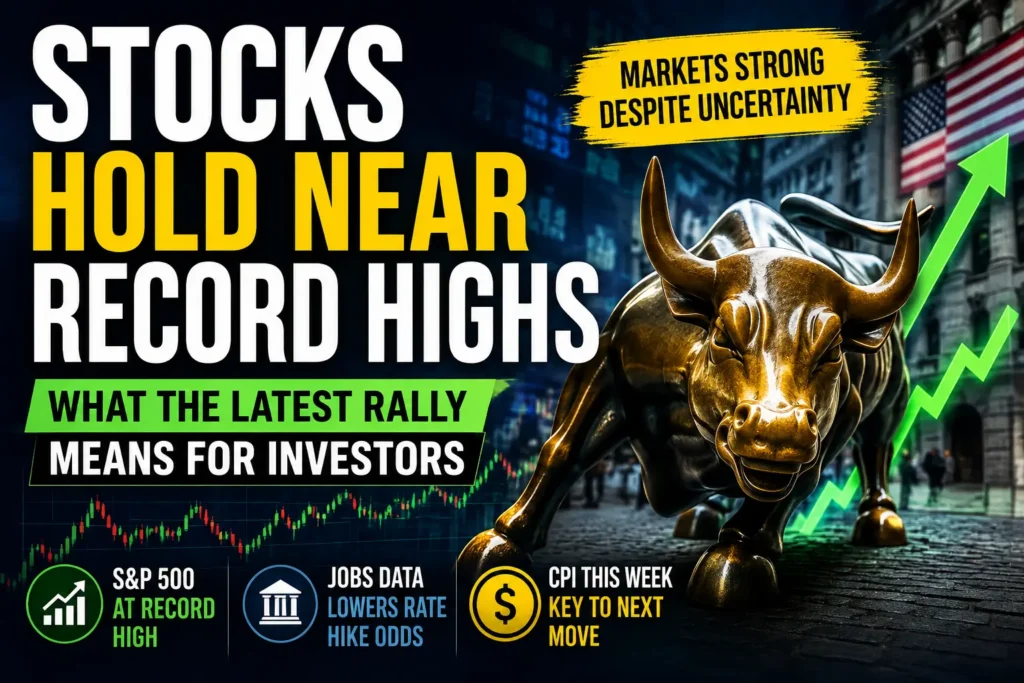
The S&P 500 closed at a record high on Friday, August 7, rising 0.62% to 7,757.64. The Nasdaq Composite gained 1.30%, while the Dow Jones Industrial Average added 0.28% to 54,036.93. All three major indexes posted their strongest weekly percentage gains since April.
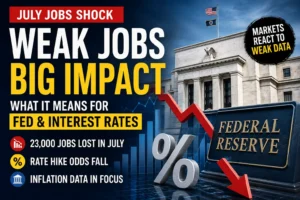
The rally followed a surprisingly weak July employment report, which showed the U.S. economy losing 23,000 nonfarm payroll jobs. The data reduced expectations for a near-term Federal Reserve rate hike and helped fuel demand for equities.
But the rally is now facing a new test.
With July consumer-price data due Wednesday and oil prices rising amid uncertainty around the Strait of Hormuz, investors are weighing whether strong corporate earnings can continue to support elevated valuations if inflation proves more persistent than expected.
Friday’s Record Close Sets the Tone
Friday’s session marked another milestone for U.S. equities.
The S&P 500 finished at 7,757.64, while the Dow reached 54,036.93 and the Nasdaq ended at 26,690.62. The weekly gains were substantial: the S&P 500 advanced 3.58%, the Nasdaq climbed 5.19%, and the Dow rose 2.96%.
The immediate catalyst was the July jobs report.
Nonfarm payrolls unexpectedly declined by 23,000, compared with economists’ expectations for an increase of about 80,000. Earlier employment figures were also revised sharply lower, while the unemployment rate fell to 4.1% as labor-force participation declined.
Markets interpreted the report as reducing the immediate pressure on the Federal Reserve to raise interest rates.
According to CME FedWatch data cited by Reuters, the probability of a September rate hike fell to approximately 44%, compared with 55% the previous session and 67% a week earlier.
Earnings Are Providing an Important Pillar of Support
The stock-market rally is not being driven by monetary-policy expectations alone.
Corporate earnings have remained a major source of support, particularly among technology and artificial-intelligence companies.
Of the 436 S&P 500 companies that had reported second-quarter results by Friday, 85.1% had exceeded analyst expectations, according to LSEG data cited by Reuters. That compares with a long-term average of about 68% since 1994.
The strength of corporate profits has helped investors look beyond concerns about elevated valuations and the enormous amount of capital being committed to AI infrastructure.
That dynamic is important because a stock market trading near record highs ultimately needs earnings growth to justify those valuations.
If profits continue to surprise on the upside, equities may have room to advance even if interest rates remain relatively high.
Monday Trading Turns More Cautious
The mood became more restrained as Wall Street began Monday’s session.
At midday, the Dow was down about 0.09%, the S&P 500 was up 0.09%, and the Nasdaq was down 0.10%. The S&P 500 was trading around 7,764.62 at that point.
The relatively muted performance reflects a market that has already priced in a substantial amount of good news.
Investors are now waiting for fresh catalysts, particularly the inflation reports due later in the week.
Energy stocks were among the strongest performers, with the S&P 500 energy sector gaining 3.3% at midday. Technology stocks, meanwhile, were weaker, with the S&P 500 information-technology index down 0.4%.
Oil Prices Add a New Inflation Risk
Geopolitical developments are also influencing markets.
Brent crude prices rose more than 4% on Monday as uncertainty surrounding the reopening of the Strait of Hormuz increased. Iran said it was close to an agreement with Oman on new shipping lanes but continued to link a reopening of the strategic waterway to conditions involving the United States.
Higher oil prices matter for investors because energy costs can feed into broader inflation.
If the rise in crude prices proves temporary, the impact on monetary policy may be limited. But a sustained increase could complicate the Federal Reserve’s efforts to bring inflation back toward its target.
That creates an important risk for stocks: the market is currently benefiting from expectations that the Fed will not need to tighten policy further, while an oil-driven inflation rebound could challenge that assumption.
Individual Stocks Are Showing How Selective the Market Has Become
Even as the major indexes remain elevated, individual stocks are experiencing sharp moves.
Intel fell after announcing a planned $15 billion share offering to help finance the expansion of its chip contract-manufacturing operations. Reuters reported that the company has significantly increased its investment plans as it attempts to compete more aggressively in advanced chip manufacturing.
Apple also came under pressure Monday after Jefferies downgraded the stock. At midday, Apple shares were down about 2%, according to Reuters.
These moves illustrate an important characteristic of the current market: a strong index does not mean every stock is rising.
Investors are increasingly differentiating between companies based on earnings expectations, valuation, capital spending and future growth prospects.
Why the CPI Report Could Be a Major Market Catalyst
The biggest scheduled economic event this week is the July Consumer Price Index report, due Wednesday.
The inflation data will be closely watched because the Federal Reserve is currently balancing two conflicting signals: a weakening labor market and inflation that remains above its desired level.
A cooler-than-expected CPI reading could reinforce the recent decline in rate-hike expectations and potentially support stocks, particularly interest-rate-sensitive growth companies.
A hotter-than-expected reading could produce the opposite reaction.
Higher inflation would make it more difficult for the Fed to ease financial conditions and could push Treasury yields and rate expectations higher.
For investors, the CPI report is therefore about more than the inflation number itself. It could influence the market’s assessment of the entire monetary-policy outlook.
Fed Expectations Remain Central to the Rally
The market’s recent performance highlights how closely equity valuations are tied to expectations for interest rates.
Under Fed Chair Kevin Warsh, the central bank has provided relatively limited forward guidance, making economic data and policymakers’ comments particularly important for investors.
The July employment report has shifted expectations toward a more cautious Fed.
But policymakers still have to consider inflation.
That leaves markets in a delicate position. A weakening economy could eventually increase the case for lower rates, but inflation that remains too high could prevent the Fed from responding as quickly as investors might hope.
This is why the next few inflation and labor-market reports could generate outsized market reactions.
J.P. Morgan Raises Its S&P 500 Target
The bullish case for stocks has also received support from Wall Street strategists.
J.P. Morgan recently raised its year-end S&P 500 target to 8,000 from 7,800, citing continued earnings strength and optimism surrounding artificial intelligence investment.
That target implies further upside from current levels, but it also underscores how much investor expectations have already improved.
A market near record highs can continue rising—but the higher valuations become, the more sensitive stocks can become to disappointing economic or earnings data.
What Investors Should Watch This Week
Several developments could determine whether the rally extends or pauses.
1. July CPI
The inflation report on Wednesday is likely to be the week’s biggest macroeconomic catalyst.
Investors will be watching headline inflation, core inflation and the underlying trend in services prices.
2. Federal Reserve Commentary
Comments from Fed officials could provide additional clues about how policymakers are interpreting the combination of weak employment and persistent inflation.
3. Oil and the Strait of Hormuz
A sustained rise in crude prices could increase inflation concerns and put renewed pressure on interest-rate expectations.
4. Corporate Earnings
Although the busiest part of earnings season is nearing its end, companies including Applied Materials and Cisco are among those scheduled to report this week.
5. AI Spending and Profit Growth
Investors will continue to assess whether enormous AI-related capital expenditures are translating into sufficient revenue and earnings growth.
That question could become increasingly important as valuations rise.
What the Rally Means for Long-Term Investors
Record highs can make investors nervous, but an expensive market is not necessarily a market that must immediately fall.
For long-term investors, the more important questions are whether corporate earnings can continue growing, whether valuations remain reasonable relative to those earnings, and whether economic conditions support continued expansion.
Short-term investors face a different challenge.
With equities near record levels, even relatively small surprises in inflation, interest rates, oil prices or earnings could trigger significant moves.
Maintaining disciplined position sizing and avoiding decisions based purely on short-term market momentum can therefore become increasingly important.
The Bottom Line
U.S. stocks enter the new week from a position of strength.
The S&P 500 has reached a fresh record, corporate earnings remain broadly strong, and expectations for an immediate Federal Reserve rate hike have fallen following the weak July employment report.
But the rally is entering a more demanding phase.
Inflation data, oil prices, Fed commentary and the sustainability of AI-driven earnings growth will determine whether the market can maintain its momentum.
For now, investors appear willing to look beyond the risks and focus on strong corporate profits and the possibility of less aggressive monetary policy.
The question is whether the economic data will continue to justify that optimism.
Disclaimer
This article is provided for informational and educational purposes only and does not constitute investment, financial, tax, legal or other professional advice. Market conditions can change rapidly. Past performance does not guarantee future results. Investors should conduct their own research and consider consulting a qualified financial professional before making investment decisions.