U.S. Jobs Shock Puts Fed Rate Outlook Under Pressure as Markets Await July Inflation Data
Published: August 9, 2026
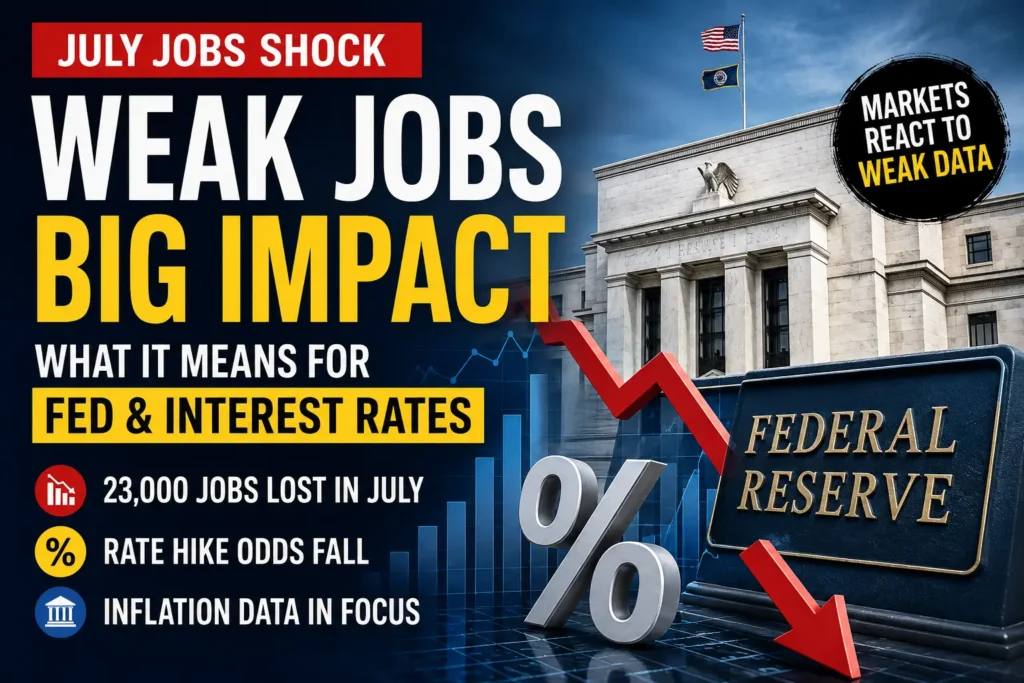
The U.S. economy lost 23,000 nonfarm payroll jobs in July, according to the latest employment report, while the unemployment rate edged down to 4.1%. The combination of weak payroll growth and a lower unemployment rate presents a mixed picture of labor-market conditions and gives policymakers another reason to proceed cautiously.
The report has already influenced financial markets, with investors reducing expectations for an imminent Federal Reserve rate increase. But the jobs data alone is unlikely to settle the debate. Inflation remains above the Fed’s 2% objective, meaning the central bank still faces a difficult balance between supporting employment and containing price pressures.
July Jobs Report Delivers a Major Downside Surprise
The July employment figures were substantially weaker than economists had expected.
Instead of adding jobs, the U.S. economy recorded a net loss of 23,000 nonfarm payroll positions. The latest data also showed substantial downward revisions to earlier employment estimates, reinforcing concerns that labor-market momentum may be weaker than previously believed.
The unemployment rate, meanwhile, fell from 4.2% to 4.1%.
At first glance, a declining unemployment rate might appear encouraging. However, the broader labor-market picture is less reassuring. A softer participation rate means that changes in the unemployment rate need to be interpreted alongside employment, participation and other measures of labor-market strength.
The July report therefore points to a labor market that may be losing momentum rather than one experiencing a straightforward improvement.
What the Jobs Data Means for the Federal Reserve
The latest figures arrive at a particularly important time for the Federal Reserve.
At its July 28–29 meeting, the Federal Open Market Committee voted 9–3 to keep the federal funds target range at 3.50% to 3.75%. Three officials—Beth Hammack, Neel Kashkari and Lorie Logan—dissented because they preferred a quarter-point rate increase.
That split illustrates the difficult policy environment facing the central bank.
The Fed is effectively balancing two competing risks:
- A weakening labor market could increase the case for keeping rates unchanged or eventually easing policy.
- Persistent inflation could require interest rates to remain restrictive for longer—or even move higher.
The Fed’s own July Monetary Policy Report said economic activity was continuing to expand at a solid pace, while inflation remained elevated relative to its 2% goal.
The July jobs report therefore adds an important new consideration, but it does not by itself determine the Fed’s next move.
Markets Reduce Expectations for a September Rate Hike
Financial markets reacted quickly to the weaker employment figures.
Expectations for a September rate increase declined, with rate futures moving to reflect a probability of less than 50% for a hike. Investors interpreted the employment report as reducing some of the pressure on policymakers to tighten monetary policy immediately.
That reaction also pushed Treasury yields lower and supported risk assets, with equities benefiting from the prospect that monetary policy may not become more restrictive in the near term.
However, markets remain sensitive to incoming inflation data.
A weaker employment report can support the case for stable or lower interest rates, but persistent inflation could quickly reverse that interpretation.
Inflation Remains the Fed’s Biggest Constraint
The key issue for the Federal Reserve is that inflation has not yet returned sustainably to its 2% target.
June’s Consumer Price Index showed headline consumer prices were 3.5% higher than a year earlier, while core CPI increased 2.6% over the same period. Energy prices were also significantly higher over the year.
This means policymakers cannot simply respond to weaker employment by assuming that rate cuts are immediately appropriate.
If inflation continues to run above target, Fed officials may remain reluctant to loosen monetary policy even as labor-market conditions deteriorate.
That tension is likely to define the next phase of the rate debate.
July CPI Could Be the Next Major Market Catalyst
The next major test for the Fed outlook will come from the July inflation data.
The Bureau of Labor Statistics is scheduled to release the July Consumer Price Index on Wednesday, August 12, at 8:30 a.m. ET. The July Producer Price Index is scheduled for August 13.
Investors will pay particular attention to:
- Core inflation
- Services inflation
- Shelter costs
- Energy prices
- Wage and labor-cost pressures
- The overall direction of inflation compared with the Fed’s 2% objective
A further moderation in inflation would strengthen the argument for patience on additional rate increases and could eventually reopen the discussion around monetary easing.
Conversely, unexpectedly strong inflation could reinforce the hawkish camp within the Fed and push rate-hike expectations higher again.
Fed Officials Remain Divided
The July FOMC decision demonstrated that policymakers are not fully aligned on the appropriate level of interest rates.
The three dissenting votes in favor of a hike were notable because they came despite the committee ultimately choosing to hold rates steady.
Federal Reserve Governor Lisa Cook has also recently indicated that she would be prepared to support higher rates if inflation fails to ease sufficiently. In remarks reported by Reuters, Cook emphasized the risk of persistent inflation and wage pressures becoming entrenched.
At the same time, the deterioration in employment data gives policymakers on the other side of the debate a stronger argument for caution.
The result is a Fed facing unusually difficult trade-offs as it approaches its next policy decisions.
Questions About Fed Independence Add Another Layer of Uncertainty
Monetary policy is also unfolding against a backdrop of renewed political pressure on the Federal Reserve.
The Trump administration has continued efforts to remove Governor Lisa Cook, with the White House citing allegations that Cook’s attorney has characterized as baseless and politically motivated. The dispute has intensified broader concerns about the independence of the central bank.
For financial markets, the issue matters because confidence in the Fed’s independence is closely linked to the credibility of its inflation-fighting policy.
Any perception that monetary policy is being influenced by short-term political considerations could add another source of volatility to bond and currency markets.
What Lower Interest Rates Would Mean for Households and Businesses
The direction of Fed policy matters well beyond Wall Street.
Interest rates influence borrowing costs across the economy, including:
- Mortgage rates
- Credit-card borrowing
- Auto loans
- Business loans
- Corporate debt
- Savings and deposit returns
If the Fed keeps rates unchanged for an extended period, borrowing costs could remain elevated even if they stop rising.
If inflation cools sufficiently to allow eventual rate cuts, households and businesses could see financial conditions gradually become less restrictive.
But if inflation proves persistent and the Fed resumes tightening, borrowing costs could rise again.
What Investors Should Watch Next
The July jobs report has changed the conversation around U.S. monetary policy, but it has not provided a definitive answer about the Fed’s next move.
The most important indicators to watch in the coming weeks include:
1. July CPI:
The August 12 inflation report will provide the next major test of the Fed’s inflation outlook.
2. Producer prices:
The August 13 PPI report could offer additional information about pipeline price pressures.
3. Labor-market revisions:
Employment data is regularly revised as additional information becomes available, making the underlying trend more important than any single monthly figure.
4. Fed communications:
Speeches and comments from policymakers could reveal whether the July jobs report is changing their assessment of the balance between employment and inflation.
5. Treasury yields and rate expectations:
Bond markets are likely to remain highly sensitive to every major economic release while uncertainty around the Fed’s next move remains elevated.
The Bottom Line
The July jobs report has delivered a clear warning that the U.S. labor market may be losing momentum.
That development reduces some of the immediate pressure for the Federal Reserve to raise interest rates. But inflation remains above target, and several policymakers continue to favor a restrictive stance.
The result is a Fed caught between two competing economic signals: a softer labor market and stubborn inflation.
For now, the most likely policy approach is to remain heavily data-dependent rather than commit to a predetermined path.
The next major piece of the puzzle arrives on August 12, when the July CPI report is released.
Until then, markets are likely to remain sensitive to every indication of whether the U.S. economy is moving toward a gradual slowdown—or toward a more difficult combination of weaker employment and persistent inflation.
Disclaimer
This article is intended for informational and educational purposes only and does not constitute financial, investment, tax, legal, or other professional advice. Financial markets and economic conditions can change rapidly. Readers should conduct their own research and consult qualified professionals before making investment or financial decisions.